Immigrant Visa Processing Paused for 75 Countries has been suspended, potentially delaying U.S. green card applications indefinitely.
On January 14, 2026, the U.S. Department of State announced that beginning January 21, 2026, it would pause the issuance of immigrant visas for citizens of 75 countries.
The suspension, which has no announced end date, is already disrupting family-based, employment-based, and investor immigration plans.
The pause affects applicants seeking permanent residence through immigrant visa categories that lead to a green card. Consequently, many individuals and employers are left wondering how to adjust their immigration strategies.
This article explains what the suspension is, which countries are impacted, why it was implemented, how public charge considerations factor in. And what applicants can do to adjust their immigration strategy.
What does Suspension Of Immigrant Visa Processing mean?
The suspension of immigrant visa processing to 75 countries means that officials will not issue new immigrant visas (the type required for permanent residence processed at U.S. embassies and consulates abroad).
Thus, the applicants from these countries while it reassesses screening procedures and eligibility standards.
This pause does not affect to:
- Non‑immigrant visas (like tourist visas, student visas such as F‑1, business visas such as B‑1/B‑2, and work visas like H‑1B).
- Adjustment of status applications already filed within the United States.
- Immigrant visas already issued and printed.
The suspension is part of a broader shift in U.S. immigration policy that places greater emphasis on vetting applicants for financial self‑sufficiency and on reducing reliance on public benefits.
Some employment-based immigrant visa applicants may still qualify for Premium Processing, which can expedite adjudication despite broader suspension-related delays.
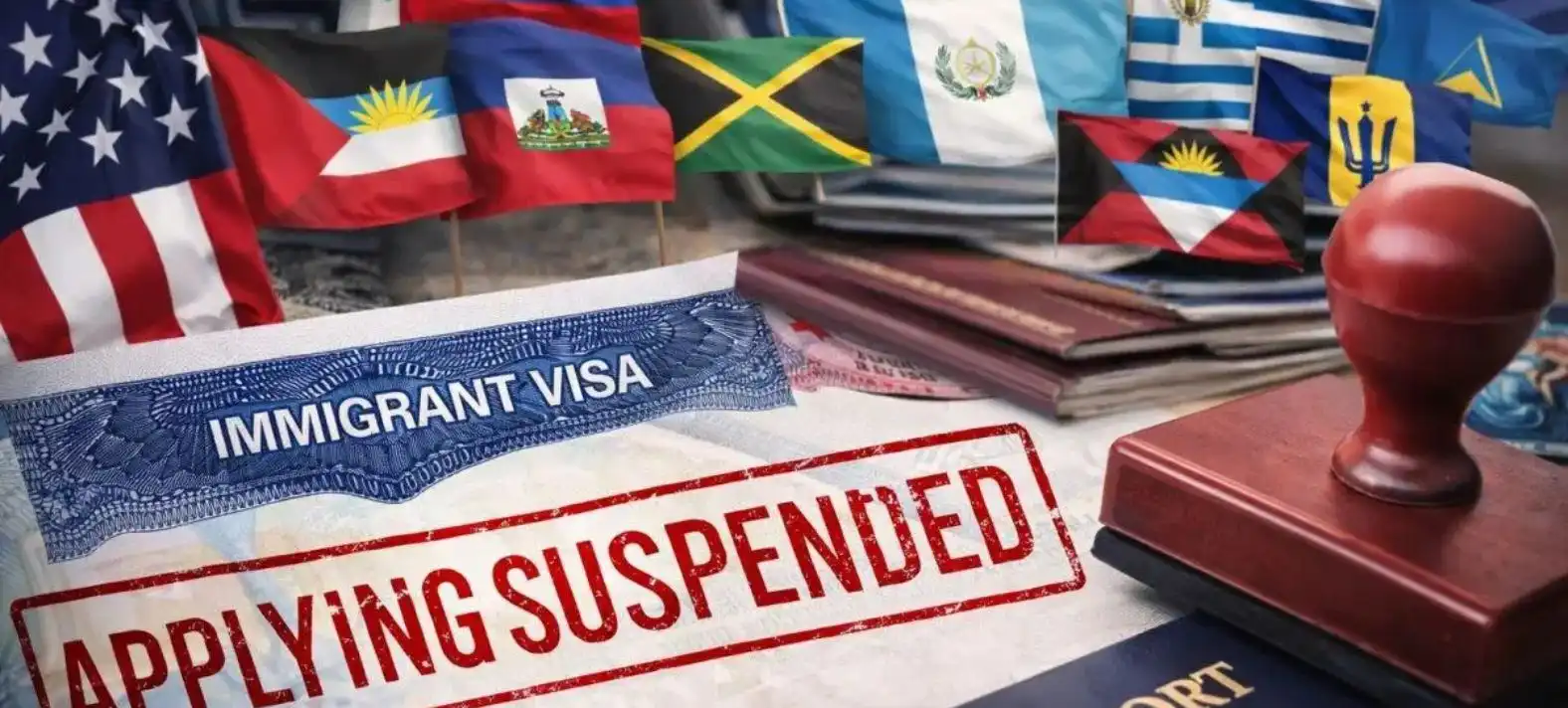
Which Countries Are Affected By The Suspension Of Immigrant Visa Processing?
While some news outlets have shared global summaries, the official guidance lists affected nationals from countries across Africa, Asia, the Middle East, Europe, the Caribbean, and the Americas.
Officials included these countries based on public charge risk assessments, historical immigration patterns, and administrative screening challenges.
Specifically, here’s the complete list of 75 countries affected by the Suspension of Immigrant Visa Processing (effective January 21, 2026).
- Afghanistan
- Albania
- Algeria
- Antigua and Barbuda
- Armenia
- Azerbaijan
- Bahamas
- Bangladesh
- Barbados
- Belarus
- Belize
- Bhutan
- Bosnia and Herzegovina
- Brazil
- Burma (Myanmar)
- Cambodia
- Cameroon
- Cape Verde
- Colombia
- Cote d’Ivoire
- Cuba
- Democratic Republic of the Congo
- Dominica
- Egypt
- Eritrea
- Ethiopia
- Fiji
- The Gambia
- Georgia
- Ghana
- Grenada
- Guatemala
- Guinea
- Haiti
- Iran
- Iraq
- Jamaica
- Jordan
- Kazakhstan
- Kosovo
- Kuwait
- Kyrgyz Republic (Kyrgyzstan)
- Laos
- Lebanon
- Liberia
- Libya
- Moldova
- Mongolia
- Montenegro
- Morocco
- Nepal
- Nicaragua
- Nigeria
- North Macedonia
- Pakistan
- Republic of the Congo
- Russia
- Rwanda
- St. Kitts and Nevis
- Saint Lucia
- Saint Vincent and the Grenadines
- Senegal
- Sierra Leone
- Somalia
- South Sudan
- Sudan
- Syria
- Tanzania
- Thailand
- Togo
- Tunisia
- Uganda
- Uruguay
- Uzbekistan
- Yemen
Officials included these countries because of a mix of public charge risk assessments, historical immigration patterns, and administrative screening challenges.
Additionally, major sending countries such as India, China, and Mexico are not on the list, prompting questions from global immigration advocates.
Why Did The U.S. Government Cite Public Assistance Concerns?
The central reason behind this suspension lies in concerns about the so‑called public charge ground of inadmissibility. Hence, a long‑standing part of U.S. immigration law that allows visa denial to applicants expected to become primarily dependent on government support.
According to the State Department, the goal of this policy is to critically reassess how immigrant visa applicants are evaluated for the likelihood of needing public benefits like welfare, long‑term medical care, or other government support once in the United States.
Furthermore, officials expanded evaluations based on guidance in November 2025 to include factors such as:
- Age and health
- Financial resources and employment prospects
- Education and job skills
- English proficiency
- Any prior use of government assistance programs
Consular officers now weigh these factors more comprehensively when adjudicating immigrant visas.
Applicants seeking employment-based visas requiring employer sponsorship may experience delays due to enhanced review of financial stability and support obligations.
How Has Public Charge Screening Changed Under This Policy?
In previous years, public charge reviews were mostly a part of the adjustment of status process inside the U.S. or a narrower review during consular processing abroad.
Now, officers assess more personal and socioeconomic details to predict reliance on public benefits.
Officers now review these criteria more closely:
- Health Conditions — Chronic medical needs that may lead to long‑term care costs.
- Income and Savings — Whether an applicant has stable income or financial support.
- Education and Employment History — Skills that influence employability.
- English Language Skills — Ability to integrate economically and socially.
Indeed, officials say these criteria help ensure new immigrants become financially self‑sufficient, reducing future burdens on public systems.
Understanding your immigrant petition meaning is crucial because consular officers will scrutinize the details of your petition more closely under the new suspension rules.
Are There Additional Reasons Beyond Public Charge Concerns?
Yes — public charge concerns remain primary. However, officials also considered:
1. Administrative and Vetting Challenges
Some countries on the US freeze visa processing for 75 countries list have historically faced issues with document fraud, identity verification problems, or limited embassy resources, prompting officials to tighten oversight.
In some cases, Officers may issue a Request for Evidence (RFE) if documentation is incomplete or verification issues arise due to these administrative challenges.
2. Broader Policy Aims
According to the US Department of state, the current policy the policy aligns with national security priorities. In addition, it reinforces recent executive actions aimed at controlling immigration flows.
For example, a separate proclamation in December 2025 suspended visa issuance to certain countries as a security measure under national security grounds.
3. Political Priorities
Meanwhile, the suspension also reflects ongoing debates over immigration policy direction in the U.S., where different administrations have shifted between more open policies and stricter enforcement.
In addition, critics argue this move represents an aggressive shift toward limiting legal immigration.
Evaluate how public charge and additional screening may affect your application with a professional petition review.
Why Does The List Include Certain Countries But Not Others?
Officials decision to suspend immigrant visas for nationals of 75 countries has prompted questions about how the list was determined.
Reports from multiple sources suggest the selection was driven by several factors, including:
- Perceived public charge risk — Countries with higher rates of immigrants historically using public assistance were prioritized.
- Administrative burden — Nations with limited consular infrastructure or higher fraud concerns were included.
- Policy focus — Some major immigrant‑sending countries are omitted, which observers say may reflect economic and diplomatic considerations.
Understanding how these decisions are made can help applicants anticipate future changes and plan routes that may be less affected by these criteria.
Could The Suspension Be Temporary Or Permanent?
The term used by the State Department is a “pause”, not a permanent ban. However, no official end date has been provided. Thus, the suspension will stay in place “while the Department reassesses immigration processing procedures,” according to Miller Mayer Law Firm.
Legal experts suggest three possibilities:
- The pause could remain for several months while new screening protocols are developed.
- Policymakers could be formalized into more permanent regulation.
- Policymakers might rescind or narrow the pause in response to legal challenges or administrative changes.
Staying informed on official announcements is essential for applicants during this uncertain period.
How Might This Policy Fit Into the Broader U.S. Immigration Trends?
The suspension follows a pattern of recent shifts in immigration policy, including expanded public charge rules and increased vetting requirements.
In addition, based on KPBS Public Media, experts say policymakers use this approach to redefine how the U.S. screens immigrants for economic self‑sufficiency.
This movement toward stricter evaluations reflects policy debates that emphasize:
- Reducing net immigration levels
- Ensuring immigrants can support themselves financially
- Tightening eligibility standards
Whatever your stance, this context matters because it influences how future visa rules may evolve — potentially affecting many immigration pathways.
Consequently, applicants traveling internationally, understanding Reentry Permit Processing Time is essential to avoid overstays while visa issuance is paused.
What Are The Immediate Impacts Of This Suspension?
If your immigrant visa interview is scheduled after January 21, 2026, applicants may face delays. Here’s what applicants should know:
Interviews May Continue, But Visas Will Not Be Issued
Even if your interview is scheduled, consular officers will not issue immigrant visas for nationals of the affected countries until the suspension ends.
Therefore, it can create uncertainty for applicants with time-sensitive plans.
No Guarantee Of A Specific Timeline For Resumption
The suspension is indefinite, and the U.S. State Department has not provided a clear end date. Thus, applicants may experience longer-than-expected delays.
Non‑Immigrant Visas Remain Available
Meanwhile, those applying for student visas, work visas, or tourist visas is not affected. Applicants for non-immigrant visas can still proceed with their plans.
Dual Nationals May Still Be Adjudicated
If you hold a passport from a country not on the 75 countries visa list, your case may still move forward despite being a national of an affected country.
As a result, this suspension could cause significant delays for families waiting to reunite, professionals awaiting job offers, or investors planning to relocate, so planning ahead is crucial.
What Should Affected Applicants Know Now?
Here’s how to respond if your case is affected:
- Monitor official State Department updates — policies and timelines can change.
- Prepare stronger documentation — especially financial evidence to address public charge concerns.
- Consider Adjustment of Status alternatives — if you are already in the U.S. and eligible.
- Stay in touch with your immigration attorney for personalized planning.
How Robinson Immigration Law Can Help Applicants Navigate The Suspension?
Facing delays due to the Suspension of Immigrant Visa Processing for 75 Countries can be stressful, but you don’t have to manage it alone. At Robinson Immigration Law, we help applicants:
- Evaluate Your Case: We review your specific situation and determine how the suspension affects your visa type.
- Explore Alternative Options: Some applicants may qualify for other immigrant visa categories or adjustment of status options.
- Prepare Strong Documentation: We guide you in gathering evidence to strengthen your application under stricter public charge and vetting requirements.
- Stay Updated On Policy Changes: Immigration rules can change quickly. We provide timely updates to help you plan next steps effectively.
Confused about work, study, or immigration visas? Download our Visa Guide to explore every option and make the best choice. Be confident in your decision.

FAQs About The Suspension Of Immigrant Visa Processing
Here are some common questions applicants are asking based on the current pause: Yes. If you hold a passport from a country not on the 75 countries visa list, your case may still proceed even if you are a national of an affected country. It’s important to stay informed, keep your documents up-to-date, and consult an immigration attorney to explore alternative visa options or strategies. Robinson Immigration Law can help evaluate your eligibility and guide you through next steps.
2. Can I Still Apply For An Immigrant Visa If I Am A Dual National?
3. What Should I Do If My visa Is Delayed Due To The Suspension?
Conclusion
In conclusion, Suspension of Immigrant Visa Processing for 75 Countries is rooted in rule changes related to public charge concerns, administrative vetting challenges, and broader immigration policy goals.
According to Visa Lawyer, government guidance and reporting officials designed this move to ensure that future immigrants remain financially self‑sufficient and less likely to rely on public assistance.
Furthermore, this affects your case, don’t wait — evaluate your options and gather evidence that strengthens your application under the new criteria.
Contact us today—so we can help evaluate your profession, assess your qualifications, and identify the best possible path to pursue your U.S. immigration goals.