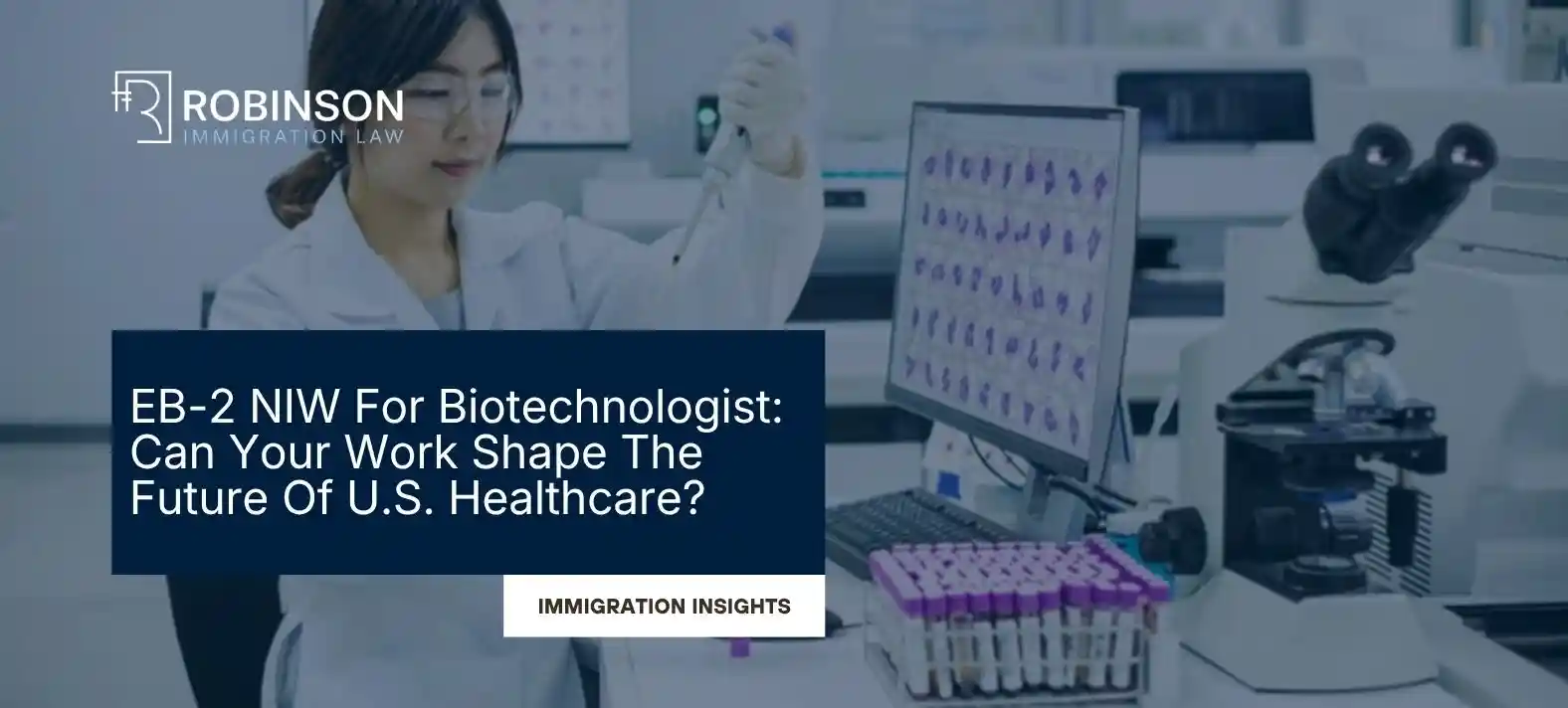
Are you a biotechnologist working on groundbreaking research and wondering if the EB-2 NIW for Biotechnologists could be your pathway to the U.S.?
The United States biotech industry is growing fast. According to the Biotechnology Innovation Organization (BIO), the sector employs more than 2.1 million people across research, manufacturing, and healthcare solutions (BIO Report). Demand for talent keeps climbing, but there aren’t enough qualified experts to fill biotechnology jobs.
That’s where the EB-2 National Interest Waiver (NIW) comes in. For many scientists, researchers, and innovators, it offers a way to contribute to U.S. progress without needing employer sponsorship.
What Makes The EB-2 NIW Different For Biotechnologists?
The EB-2 NIW is part of the employment-based second preference visa category. Unlike traditional green card routes, the NIW allows you to skip the PERM labor certification process if you can demonstrate that your work benefits the U.S.
For a biotechnologist, this could mean showing how your research supports advancements in:
- Gene therapy
- Vaccine development
- Agricultural biotech
- Drug discovery
- Personalized medicine
These areas don’t just generate profits—they strengthen national health security, create jobs, and drive innovation.
Example: A biotechnologist developing a novel cancer therapy may argue that their research has both medical and economic benefits. That strengthens the case for a waiver because the work addresses a national interest.
Who Is Eligible For EB-2 NIW For Biotechnologist?
The EB-2 NIW has specific eligibility requirements. You need to meet either the advanced-degree standard or the exceptional-ability standard.
For biotechnologists, this often means:
- Holding a Master’s degree or Ph.D. in biotechnology, biology, bioinformatics, or related sciences.
- Having substantial research contributions or industry experience.
- Showing your work impacts the biotech industry in ways that benefit the U.S.
If you’re asking, “How do I check if I am eligible for EB-2 NIW?”, the short answer is: it depends on your academic background, publications, research, and professional achievements.
USCIS uses a three-prong test from Matter of Dhanasar (2016):
- Your work must have substantial merit and national importance.
- You must be well-positioned to advance that work.
- Waiving the job offer requirement must benefit the U.S.
Think of it this way: a biotech researcher working on solutions for antibiotic resistance is not just doing science—they’re addressing a global health crisis. That’s the type of contribution the NIW was designed to encourage.
Is It Difficult To Get An EB-2 NIW As A Biotechnologist?
The process isn’t simple, but it’s achievable with the right evidence. The challenge lies in documenting your impact. USCIS officers won’t take your word for it—they want proof.
Strong applications often include:
- Peer-reviewed publications and citations.
- Evidence of patents or innovation.
- Recommendation letters from experts.
- Proof of grants, funding, or awards.
- Media coverage of your research.
Some applicants also receive a Request for Evidence (RFE) when USCIS wants additional proof. This is common and doesn’t mean denial—it just means you need to strengthen your petition.
Here’s a real scenario: A biotechnologist working in plant genetics applied under EB-2 NIW, demonstrating how their research improved crop resilience. They provided government reports, scientific citations, and expert letters. The petition was approved because food security is a recognized national priority.
What Are The Disadvantages Of EB-2 NIW For Biotechnologist?
While EB-2 NIW offers flexibility, there are some drawbacks:
- Processing times can be long. USCIS processing can take over a year, though Premium Processing is now available in some NIW cases.
- No guaranteed approval. Even qualified biotechnologists must prove their work benefits the U.S. beyond their own career advancement.
- Evidence-heavy process. Unlike employer-sponsored visas, the burden of proof falls entirely on you. Collecting publications, recommendation letters, and impact reports takes significant effort.
Despite these challenges, many biotechnologists choose this route because the benefits outweigh the disadvantages. No job offer requirement means you’re free to pursue research in academia, startups, or private labs.
How Does The EB-2 NIW Support The U.S. Biotech Industry?
The U.S. biotech industry contributes over $1 trillion annually to the economy (BIO Industry Report, 2023).
However, labor shortages in specialized fields such as molecular biology and genetic engineering make it hard to meet the growing demand.
This is where immigrant researchers shine. Studies show that high-skilled immigrants drive a disproportionate share of U.S. innovation—they are ~16% of inventors but produce ~23% of patent output, helping ideas diffuse globally, according to the NBER.
International biotechnologists fill this gap. Their contributions help accelerate drug development, strengthen healthcare infrastructure, and create new biotech startups.
For example, during the COVID-19 pandemic, biotech experts worldwide worked on vaccines and therapies. Many would not have been able to contribute if immigration policies were stricter. The EB-2 NIW ensures that the U.S. can continue to attract talent for urgent national priorities.

How Do Biotechnologists Build A Strong NIW Petition?
If you’re in biotechnology, here’s how to position your petition effectively:
- Highlight your research impact. Show how your work addresses healthcare, agriculture, or environmental challenges.
- Use data and recognition. Citations, patents, or grant awards strengthen your case.
- Connect to U.S. priorities. Link your work to public health, energy security, or innovation growth.
Example: If you’re working on biodegradable plastics from biotech processes, emphasize how your innovation supports U.S. sustainability goals.
And remember: your priority date matters. Many applicants wonder, “What does the priority date mean for immigration?” Simply put, it’s your place in line for a green card. If visa demand exceeds supply, visa retrogression may delay your approval.
Want to know if your biotech expertise qualifies? Get a free case evaluation.
FAQs About EB-2 NIW For Biotechnologists
2. Is It Difficult To Get An EB-2 NIW?
It’s not easy, but many biotechnologists succeed if they provide strong evidence. The key is showing your work benefits the U.S. in areas like healthcare, environment, or innovation.
3. What Are The Disadvantages Of EB-2 NIW?
The main disadvantages are long processing times and the need to provide extensive documentation. However, for many biotechnologists, the independence from employer sponsorship outweighs these challenges.
4. Can I Apply For EB-2 NIW If I Already Have H-1B status?
Yes. Many professionals transition from H1B to green card through EB-2 NIW because it allows them to self-petition without needing an employer’s permanent sponsorship. In fact, research shows immigrant founders and skilled professionals are central to U.S. innovation leadership—60% of top U.S. AI companies have at least one immigrant founder.
Conclusion
The EB-2 NIW for a biotechnologist is more than just a visa option. It recognizes that your work in the biotech industry has real national value.
Whether you’re developing new therapies, improving food security, or advancing genetic research, your contributions could shape the future of U.S. innovation.
According to the American Immigration Council, nearly 46% of Fortune 500 companies were founded by immigrants or their children, proving how vital immigrant scientists and entrepreneurs are to America’s progress
Contact us so we can help evaluate your profession and guide you through the EB-2 NIW process.