Is the falling EB-2 NIW approval rate a sign that your national interest waiver won’t work?
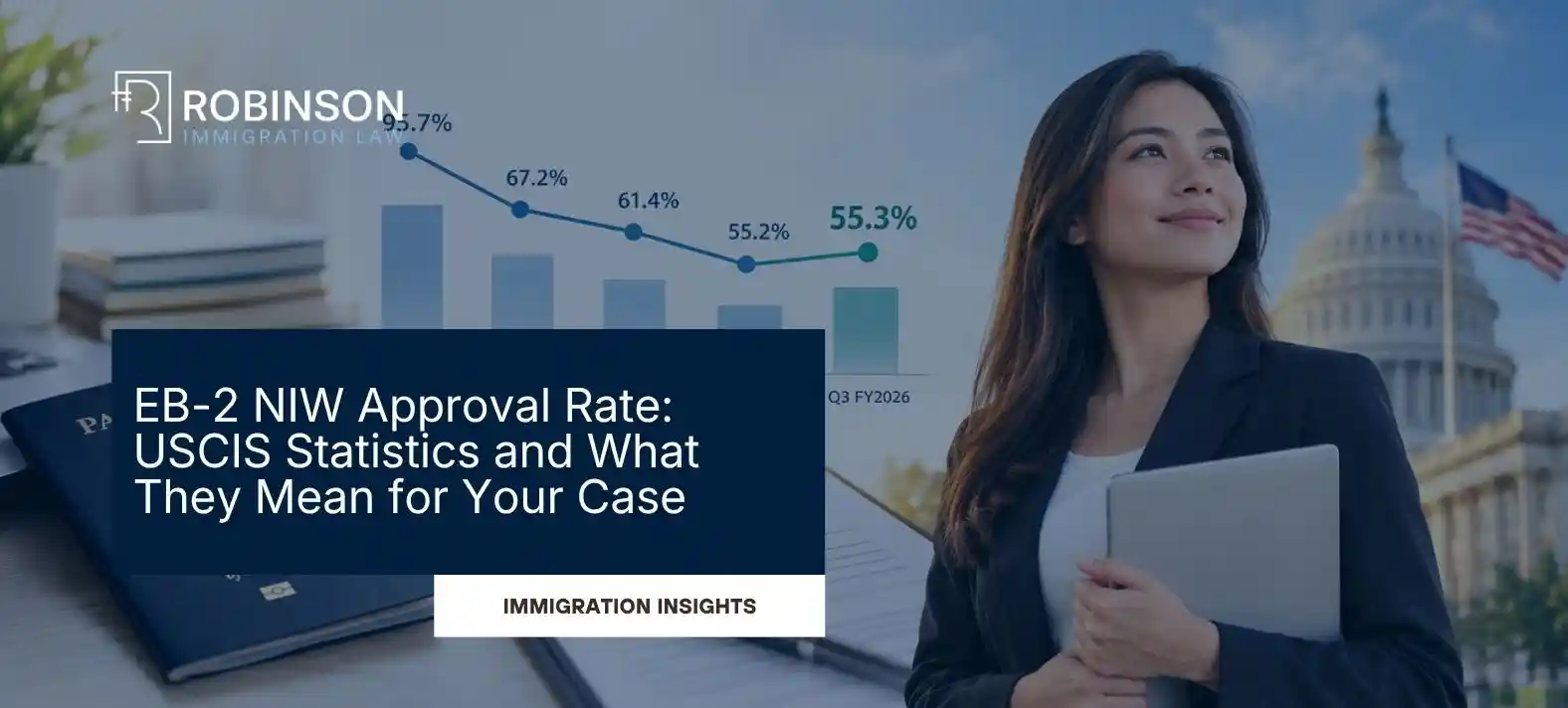
If you’ve spent years building your career, research, or business, that question feels personal. Approvals dropped from 95.7% in FY2022 to about half of decided cases by 2025. It’s fair to wonder whether filing is worth the time and money.
The answer matters because the EB-2 NIW puts you in control. You don’t need an employer sponsor, a job offer, or PERM labor certification. You can self-petition, get a decision in 45 business days with premium processing, and lock in your priority date on your own timeline.
The approval rate doesn’t decide your case. Your petition does. This guide covers the latest USCIS numbers, why rates fell, how your profile affects your chances, how NIW compares with EB-1A and O-1A, and what to do if you’re denied.
What Is the Current EB-2 NIW Approval Rate?
According to a USCIS report, 55.3% of EB-2 NIW petitions were approved in Q3 of FY2026, with 6,938 cases decided. It was the first quarter since mid-2025 with more approvals than denials.
Approval Rates by Fiscal Year and Quarter
| Period | Approved | Denied | Approval Rate |
|---|---|---|---|
| FY2022 | 10,316 | 468 | 95.7% |
| FY2023 | 31,889 | 8,172 | 79.6% |
| FY2024 | 27,526 | 11,256 | 71.0% |
| FY2025 | 19,532 | 15,863 | 55.2% |
| FY2025 Q4 | 2,968 | 5,356 | 35.7% |
| FY2026 Q1 | 2,380 | 3,206 | 42.6% |
| FY2026 Q2 | 3,042 | 3,283 | 48.1% |
| FY2026 Q3 | 3,835 | 3,103 | 55.3% |
What the Statistics Don’t Tell You
USCIS calculates the rate as approvals divided by approvals plus denials. The figure blends every petition, including rushed filings with template letters. USCIS doesn’t break it down by degree, field, or whether an attorney prepared the case.
So a 55% rate doesn’t give you coin-flip odds. It describes the average petition, and a well-built case is judged against the legal standard, not the average.
Wondering whether the EB-2 NIW approval rate affects your chances? Approval statistics only tell part of the story. A strong EB-2 NIW petition is built on clear evidence, a well-defined proposed endeavor, and a compelling national-interest argument. For a deeper understanding of eligibility requirements and how USCIS evaluates petitions, review our comprehensive EB-2 NIW guide.
Why Has the EB-2 NIW Approval Rate Dropped?
Three forces drove the decline.
The 2022 Expansion and Filing Surge
In January 2022, following Executive Order 14012, USCIS issued guidance that read “national interest” broadly, especially for STEM graduates and entrepreneurs. Approvals soared, and so did applications. Receipts nearly tripled by FY2024, and many were weak or premature.
Stricter Dhanasar Review
Every NIW petition must satisfy the three-prong Matter of Dhanasar test:
- The proposed endeavor has substantial merit and national importance.
- You are well positioned to advance it.
- On balance, waiving the job offer and labor certification benefits the U.S.
Since 2023, officers have demanded measurable impact and concrete evidence. Moreover, a January 2025 manual update reinforced that the endeavor itself, not your field or degree, must carry national importance.
More RFEs and NOIDs
Requests for Evidence and Notices of Intent to Deny are now common. They aren’t denials, but weak responses often lead to one.

Does Your Profile Affect Your EB-2 NIW Approval Chances?
Your profile shapes what evidence you have, not your odds on its own.
PhD Holders and Researchers
Publications, citations, and grants map neatly onto the “well positioned” prong. The weak spot is usually national importance. You must show why your future work matters to the U.S., not just to your field.
STEM Professionals in Industry
Patents, deployed systems, and measurable outcomes can replace publications. The challenge is proving impact beyond your employer. USCIS itself cites a software engineer adapting company code for clients as a case that will struggle without broader evidence.
Entrepreneurs and Business Professionals
USCIS guidance welcomes entrepreneurs and lists useful evidence: a detailed business plan, interest from investors or customers, a proven track record, and projections for revenue and job creation. Present results as documented numbers, not pitch-deck adjectives.
Applicants Without a PhD
You qualify for EB-2 with a master’s degree, a bachelor’s plus five years of progressive experience, or exceptional ability. Your credentials and experience must relate to your proposed endeavor.
How Does the EB-2 NIW Approval Rate Compare With EB-1A and O-1A?
NIW isn’t automatically the easier path. USCIS data shows EB-1A approved at 66.9% in FY2025 versus NIW’s 55.2%. By Q2 of FY2026, that flipped to 41.7% for EB-1A and 48.1% for NIW.
| Factor | EB-2 NIW | EB-1A | O-1A |
|---|---|---|---|
| Visa type | Green card | Green card | Temporary work visa |
| Employer required | No | No | Yes (employer or agent) |
| Core standard | Dhanasar three-prong test | Sustained acclaim, 3 of 10 criteria | Extraordinary ability, 3 of 8 criteria |
| Best fit | Impactful future work | Top-tier recognized experts | Working in the U.S. while building a green card case |
Many strong candidates qualify for more than one and file strategically. EB-1A can also mean shorter visa bulletin waits for applicants born in India or China.
What Separates Approved EB-2 NIW Petitions From Denied Ones?
Approved petitions share a few traits.
A Specific Proposed Endeavor
“Software engineer” is an occupation. “Building fraud detection systems that reduce payment losses for U.S. banks” is an endeavor. If you can’t describe yours in two specific sentences, you’re not ready to file.
Evidence of Impact Beyond One Employer
USCIS states that benefits to a single company don’t establish national importance. Connect your work to recognized priorities like health, security, or AI.
Strong Letters and a Clear Waiver Argument
Independent expert letters citing specific results matter more than generic praise. Don’t skip prong three: explain why making you go through employer sponsorship would cost the U.S. something. A labor shortage alone isn’t enough.
Does an Approved EB-2 NIW Petition Mean You’ll Get a Green Card?
Not right away. An approved I-140 confirms your eligibility, but you still need an available visa number. As of the August 2026 Visa Bulletin, EB-2 was current for every country except India and China, which face long backlogs. Filing early secures your priority date, the date that holds your place in line.

What Happens If Your EB-2 NIW Petition Is Denied?
A denial rarely ends your path to a green card.
Your Options After a Denial
- Respond strongly to any RFE or NOID before a decision is made. This is your best chance to fix gaps.
- File a motion to reopen or reconsider on Form I-290B within 30 days (33 if mailed).
- Appeal to the AAO if the officer misapplied the Dhanasar framework.
- Refile a stronger petition. There’s no waiting period.
- Pursue EB-1A, O-1A, or PERM if another route fits better.
How a Denial Affects Your Status
An I-140 denial doesn’t cancel your H-1B, F-1, or other status. But a concurrently filed I-485 will likely be denied too. If you depend on that pending application to stay in the U.S., talk to an attorney right away.
How Robinson Immigration Helps with Your EB-2 NIW Petition?
Statistics describe the average case. Our job is to make sure yours isn’t average.
Robinson Immigration Law starts with an honest assessment of your profile against all three Dhanasar prongs. If NIW isn’t your strongest option, we’ll tell you before you spend money on filing. From there, we help you:
- Define a specific, defensible proposed endeavor
- Build evidence mapped to each Dhanasar prong
- Secure letters from the right independent experts
- Respond to RFEs and NOIDs with targeted evidence
- Plan next steps if a petition is denied
We don’t promise approvals, and no honest attorney does. Additionally, we offer a clear read on your position and a petition built to the standard officers apply.
FAQs About the EB-2 NIW Approval Rate
2. Is EB-2 NIW hard to get?
It's harder than in 2022, but strong petitions with a specific endeavor and measurable results are still approved regularly.
3. Can I get an EB-2 NIW without a PhD?
Yes. A master's degree, a bachelor's plus five years of progressive experience, or exceptional ability qualifies you.
4. Does an RFE mean my EB-2 NIW will be denied?
No. An RFE asks for more evidence, and a focused response can lead to approval.
5. Does premium processing improve my approval chances?
No. For $2,965, premium processing gets you a decision in 45 business days instead of roughly 14 to 24 months. It buys speed, not approval.
Conclusion
The EB-2 NIW approval rate has climbed for three straight quarters, but the average isn’t a verdict on your case. Approval depends on how well you prove your work matters to the United States, and that’s within your control.
If you’re wondering whether an NIW will work for you, or what happens if it doesn’t, let’s talk. Additionally, we’ll review your profile, compare options across EB-2 NIW, EB-1A, and O-1A, and provide a clear plan forward.
Request a free evaluation with Robinson Immigration Law today.