What does extraordinary ability look like for a musician whose career was built mostly on streaming platforms? It looks the same as it always has under the regulation: sustained distinction above the ordinary level of the field, but the evidence that proves it now lives somewhere different- in catalog rankings, chart algorithms, and genre-specific trade press rather than label deals or Grammy nominations.
For many artists navigating the modern music industry, the O-1B visa remains one of the most effective pathways to perform and work in the United States, based on demonstrated distinction in the arts. As the industry has shifted toward digital platforms, musicians increasingly need to present evidence that reflects how success is measured today.
Read our full O-1B visa guide for the baseline eligibility criteria and filing process. This article picks up where that baseline leaves off, focusing specifically on how streaming-era evidence fits the existing legal standard.
The regulation has not changed. As stated in 8 CFR 214.2(o)(3)(ii), distinction continues to be defined as “a high level of achievement… substantially above that ordinarily encountered.” Petitioners generally still need to meet three of the six criteria set forth in 8 CFR 214.2(o)(3)(iv)(B). The burden of proof is still the preponderance of the evidence standard, making the claim more likely than not true, under the rule that “[t]ruth is to be determined not by the quantity of evidence alone but by its quality.” Matter of Chawathe, 25 I&N Dec. 369, 376 (AAO 2010) (quoting Matter of E-M-, 20 I&N Dec. 77, 80 (Comm’r 1989)).
What has shifted is the type of evidence a streaming-era artist actually has: Spotify catalog rankings, Beatport chart positions, YouTube views, and coverage in trade publications tied to genres that emerged in digital-first spaces. The considerations that follow are neither new nor the only ones that matter. They reflect a handful of practical points that practitioners in this space have been refining for years, brought together here as a contribution to an ongoing conversation.

How Should Streaming Numbers Be Put in Proportion for an O-1B Petition?
Stream counts in the millions sound impressive. On their own, though, they don’t always carry the weight they could. What gives a stream count adjudicatory force is proportion.
According to Spotify’s Loud and Clear transparency report, the scale is visible: in 2025 alone, more than 400,000 songs were streamed over a million times from an official catalog of more than 100 million tracks. A track that surpasses even that threshold already falls into a small minority of recorded music on the platform. Spotify’s Loud and Clear ranking tool lets a petitioner go further by entering a track’s all-time stream count and receiving its rank across the platform’s catalog.
According to 2025 data, a track with 8.1 million all-time streams ranks among the top 299,000 tracks on the platform, placing it in approximately the top 0.3% of a catalog of more than 100 million tracks.
The exact percentile shifts year over year, but the principle stays the same. “Eight million Spotify streams” on its own doesn’t say much. “Eight million Spotify streams, placing the track in the top 0.3% of Spotify’s catalog of more than 100 million tracks,” by contrast, speaks the regulation’s own language of “substantially above that ordinarily encountered.”
The same logic applies to YouTube view counts and to Beatport chart positions for electronic producers. Adjudicators don’t need persuading that Spotify and YouTube are major platforms; they need the math that turns raw numbers into rank. The relevant data lives in artists’ platform dashboards, including Spotify for Artists, Apple Music for Artists, and YouTube Studio, as well as third-party analytics tools such as Soundcharts and platform-specific ranking systems like Spotify’s Loud and Clear and Beatport charts. The percentile carries the greatest persuasive force when it appears in the body of the argument itself, not buried in an exhibit caption.
Why Does Each Chart Speak for Its Own Market?
Charts from international markets are often translated back to Billboard as shorthand: ARIA as “the Australian Billboard,” the UK Official Charts as “the British Billboard,” Beatport as “the Billboard of electronic music.” The translation isn’t inaccurate, but it can undersell the evidence.
Each of these charts measures a market in its own right. The Australian Recording Industry Association operates ARIA as the country’s principal music industry body. The UK Official Charts Company is jointly owned by the British Phonographic Industry and the Entertainment Retailers Association, and its weekly rankings serve as the official record of music sales in the United Kingdom. Beatport is the dominant charting platform for electronic dance music globally, and its Top 100 serves as the genre’s principal commercial benchmark.
Build the chart’s standing within its actual market inside the petition itself. Identify the body that runs it, summarize its methodology, and cite the third-party recognition that establishes its industry authority, including IFPI affiliations, official-charts-body status, and trade press coverage. A peak position of #5 on the UK Official Physical Singles Chart, or #3 on ARIA’s Top 20 Australian Albums, should first be contextualized within its own market before being translated into a Billboard equivalent.

Why Does Trade Press Count as Evidence for an O-1B Petition?
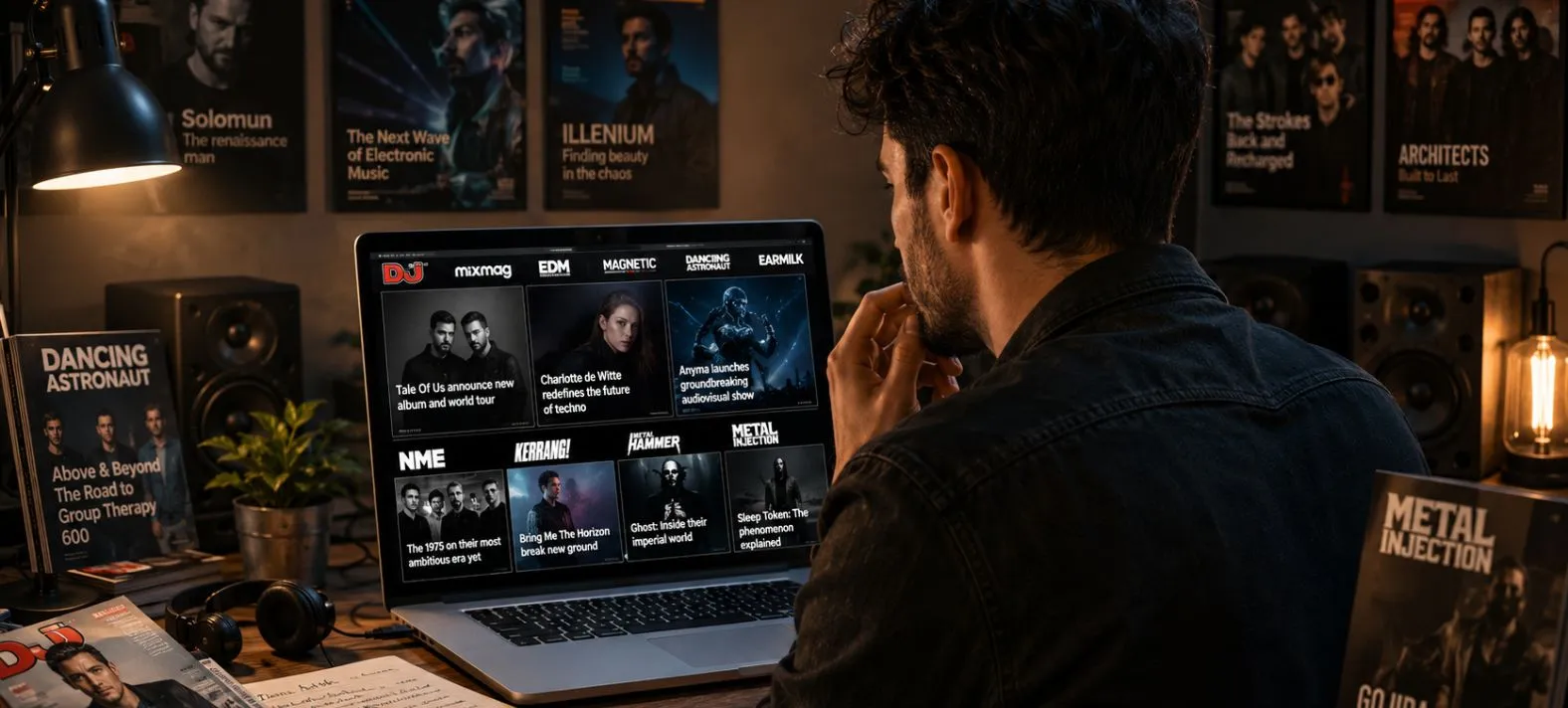
DJ Mag, Mixmag, EDM.com, Magnetic Mag, Dancing Astronaut, and Earmilk are not Rolling Stone. They’re also not merely blogs. They’re the principal trade publications for electronic and dance music, precisely the type of “major newspapers, trade journals, magazines, or other publications” recognized under 8 CFR 214.2(o)(3)(iv)(B)(2) as evidence of national or international recognition. The same logic applies across genres: NME for rock and indie; Kerrang!, Metal Hammer, and Metal Injection for metal. Several of these publications, including NME and Kerrang!, discontinued their print editions in recent years and now operate entirely online. That transition doesn’t diminish their standing within their respective fields; it reflects how those fields themselves have evolved.
The best framing is anchored in each publication’s actual field: who reads it, the scale of its readership in its category, and where it sits in the hierarchy of recognition within that genre ecosystem.
Media coverage often works most effectively when paired with strong testimonial evidence from industry professionals. This is one reason practitioners frequently advise artists on how to write a letter of recommendation for immigration purposes, ensuring expert opinions reinforce the significance of chart rankings, press features, and commercial success.
Do Awards Outside the Grammys Count Toward an O-1B Petition?
Most adjudicators recognize the Grammys. Fewer recognize the BRIT Awards, the ARIA Music Awards, the Juno Awards, the Premios Gardel, the MOBO Awards, or the MAMA Awards. All of them are the leading national music awards in their respective markets, and several are adjudicated by industry academies that mirror the Recording Academy’s structure.
As provided in 8 CFR 214.2(o)(3)(iv)(A), “significant national or international awards or prizes in the particular field such as an Academy Award, an Emmy, a Grammy, or a Director’s Guild Award” are expressly recognized. The “such as” language is doing substantive work: the mentioned awards are illustrative, not an exhaustive list. A BRIT, an ARIA, or a Premios Gardel qualifies as a “significant national or international award” in its market, and the petition can establish it directly under (A).
The petition must establish the award the same way it would establish the Recording Academy: identify the issuing body, the eligibility pool, the voting process, the award’s standing within its national industry, and the size of the field it competes in. A nomination, not only a win, can carry significant weight when properly framed against the scale of the eligible pool.
How Did One Electronic Producer’s O-1B Petition Put These Principles Together?
A Berlin-based producer working in techno had built a genuinely strong career by digital-first standards: three tracks with over five million Spotify streams each, a handful of Beatport Top 100 placements, and steady coverage in Mixmag and Dancing Astronaut. His first draft petition listed these facts more or less as bullet points, five million streams here, a chart placement there, without connecting any of it to what the regulation actually asks for.
Reworking the case meant running each stream count through Spotify’s own ranking tool to establish percentile rather than raw numbers, and building out a short explanation of Beatport’s role as the genre’s principal commercial benchmark rather than assuming the adjudicator already knew that. The trade press citations were reframed around readership and standing within the electronic music ecosystem specifically, rather than left to speak for themselves. Two of his Beatport placements, combined with the percentile-framed streaming data and the trade press evidence, satisfied three separate regulatory criteria instead of one weak, repetitive showing.
The petition was approved without an RFE. The lesson underneath the specific numbers: the underlying achievements were already extraordinary by genre standards, but the first draft never translated them into language the regulation actually rewards. That translation work, not additional achievement, was what made the difference.
What Patterns Matter Most When Building This Kind of Case?
A few patterns keep surfacing in this kind of work:
- Stream and view counts do their best work in proportion, not in absolute numbers.
- Charts and awards speak for themselves; situating them within their own markets tends to read stronger, and translating them into U.S. equivalents adds useful context on top of that, not instead of it.
- Trade press is trade press, and the regulation already recognizes that, including when it’s digital-first.
- Clear organization matters just as much as strong evidence. Presenting streaming metrics, chart performance, and trade publication coverage with appropriate context can reduce the likelihood of a Request for Evidence and make it easier for adjudicators to understand the artist’s achievements.
None of this changes what distinction means under the regulation. What has shifted is where the evidence of distinction resides and how a petition needs to organize that evidence to make its case. There’s more to say on this than fits in a single article, but these are some of the patterns worth setting out first.
How Can Robinson Immigration Law Help Streaming-Era Artists Prove Extraordinary Ability?
Building an O-1B petition for a streaming-era artist requires more than gathering evidence; it requires knowing how to frame it. Robinson Immigration Law regularly works with musicians, producers, and performers whose careers were built on platforms, playlists, and genre-specific ecosystems rather than conventional label infrastructure.
From contextualizing Spotify rankings and Beatport chart positions to establishing the authority of international awards and trade publications, the firm translates a modern music career into the language regulations require. Depending on timing and eligibility, artists may also explore premium processing for faster adjudication, particularly when upcoming tours, performances, or recording commitments require a quicker decision.
FAQs About the O-1B Visa for Streaming-Era Musicians
Do digital-only trade publications count under the O-1B criteria?
Yes. DJ Mag, Mixmag, NME, and Kerrang! all qualify as "trade journals or other publications" under 8 CFR 214.2(o)(3)(iv)(B)(2) regardless of print status. What matters is framing them accurately: identifying their readership, editorial scope, and standing within their genre's hierarchy.
Does a non-U.S. award nomination carry weight in an O-1B petition?
It can. The Grammy is illustrative, not the ceiling. A BRIT, ARIA, Juno, or MOBO nomination can qualify under 8 CFR 214.2(o)(3)(iv)(A) when the petition establishes the award's issuing body, eligibility pool, and national standing. A nomination framed against the scale of the eligible field can carry real weight even without a win.
Conclusion
The O-1B standard hasn’t changed. What has changed is where the evidence lives. For artists whose careers were built on platforms and genre-specific ecosystems, the work is largely interpretive: turning stream analytics into proportions, situating international charts and awards within their own markets, and treating the trade press as the trade press it already is under the regulation.
If you’re a streaming-era musician exploring the O-1B, the team at Robinson Immigration Law works regularly with artists navigating exactly this landscape.
Request your free evaluation and let’s discuss your case.