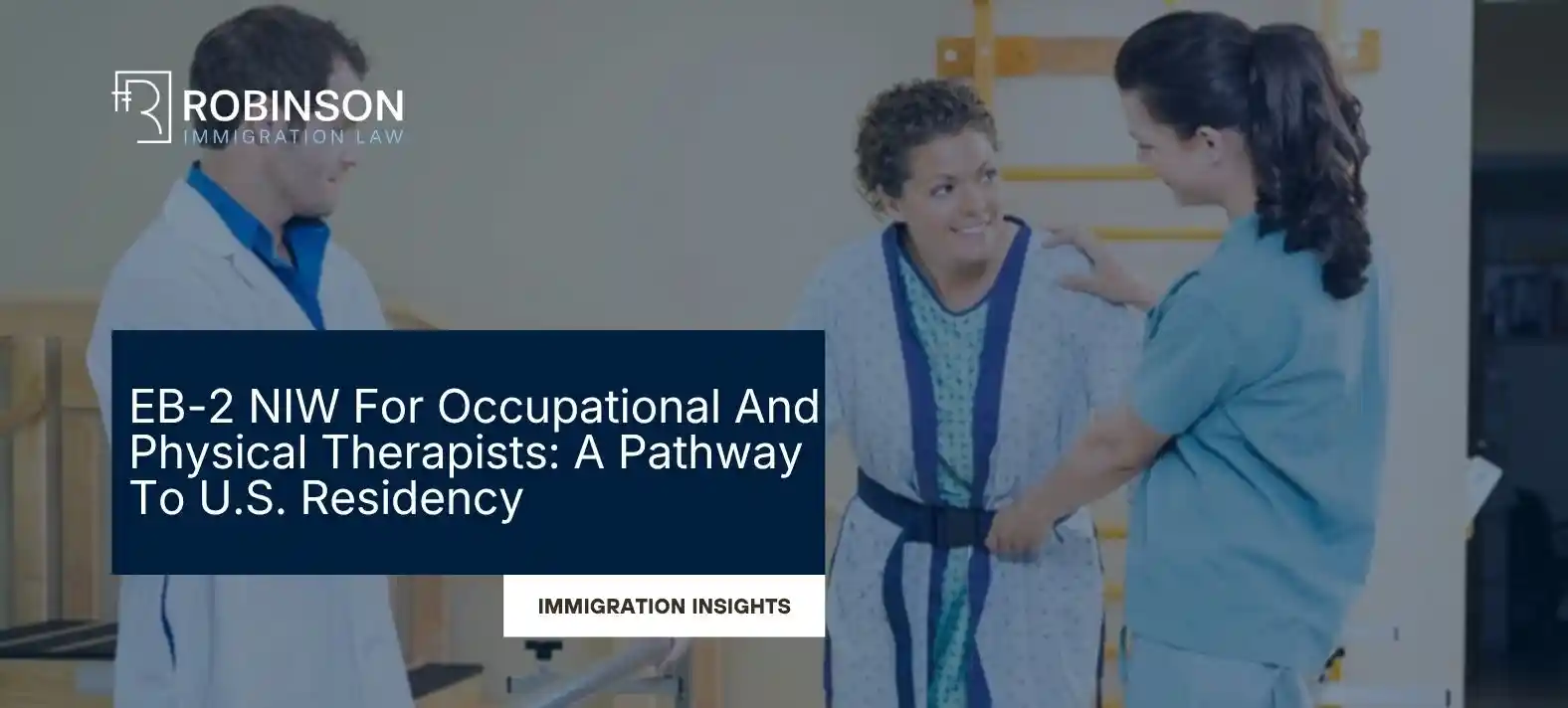
Can a foreign-trained physical or occupational therapist qualify for a U.S. green card? Yes. With the U.S. facing a well-documented shortage of rehabilitation professionals, the EB-2 National Interest Waiver lets qualified PTs and OTs self-petition for permanent residency once they meet U.S. licensing requirements; no employer sponsorship or PERM labor certification required. This guide covers PT- and OT-specific eligibility and evidence; for the broader healthcare picture including nurses and physicians, our EB-2 NIW for healthcare workers article covers that ground.
With the rising need for rehabilitation services across America, physical and occupational therapists are in high demand. The Bureau of Labor Statistics projects double-digit growth in these fields over the next decade, underscoring just how essential this work is to the national healthcare system.
What Is The EB-2 NIW And Why Does It Matter For Therapists?
Normally, EB-2 visas require employer sponsorship and PERM labor certification. With the NIW, you self-petition instead; no job offer or employer required. Our EB-2 NIW visa guide covers the full eligibility framework in depth.
For occupational and physical therapists, the case usually builds around a documented need: if you can show your work serves the national interest, improving patient recovery, reducing disability, or expanding access to rehabilitation care, you’re in a strong position to qualify.
Curious if your background meets EB-2 NIW requirements? Request a free evaluation today.
Can A Physiotherapist Get A Green Card In The USA?
Yes. The EB-2 NIW is one of the most promising routes for physical therapists because it recognizes the direct value of healthcare work to national development. A foreign-trained physiotherapist helping stroke patients regain mobility, or working in an underserved community, has a strong argument: the work directly improves public health outcomes, which is exactly what strengthens a petition.

What Fields And Professions Commonly Qualify For EB-2 NIW?
EB-2 NIW isn’t limited to therapists. It applies broadly wherever work benefits U.S. society, including physicians and healthcare professionals, researchers and scientists, engineers, educators in critical shortage areas, and public health experts. Occupational and physical therapy fall squarely into healthcare, one of the most consistently in-demand fields.
Within healthcare specifically, therapists working in rural areas with limited rehabilitation clinics, or those helping veterans and disabled patients reintegrate into daily life, tend to build particularly strong cases. This isn’t about filling any open position; it’s about showing your work impacts society at a national level, which is also why many applicants compare EB-2 NIW against EB-3: NIW offers a self-petitioning independence that EB-3 doesn’t.
How Do I Move To The USA As A Physiotherapist?
Moving to the U.S. as a physiotherapist involves two main steps. First, get your credentials evaluated and pass the required licensing exams. Second, apply for immigration status, where EB-2 NIW comes in.
To qualify, you’ll generally need to:
- Hold an advanced degree or equivalent, such as a master’s or doctorate in physical therapy
- Prove your work benefits U.S. healthcare
- Show evidence of your contributions, patient outcomes, publications, or leadership in your field
Visa retrogression can affect your timeline after approval depending on your country of birth, so it’s worth planning around that early rather than after your petition is filed.
Is Physical Therapy In Demand In The USA?
Absolutely. Physical therapy is one of the fastest-growing healthcare professions in the U.S., driven by aging baby boomers, rising rates of chronic conditions, and growing demand for rehabilitation services. The BLS projects over 38,000 new physical therapy jobs by 2032, and occupational therapy is seeing similarly strong growth, with a 12% projected increase in employment over the same period.
That demand makes the EB-2 NIW route especially favorable for therapists specifically. You’re not just filling a job, you’re addressing a documented national shortage, which is the core of what a strong NIW petition needs to show.

Can A Foreign Physical Therapist Work In The USA?
Yes, but licensing comes first. According to FSBPT, Foreign physical therapists typically need to pass the National Physical Therapy Examination (NPTE) and meet state-specific requirements. EB-2 NIW handles the immigration side separately, letting you apply for a green card based on your national impact rather than a specific job offer.
An Indian-trained physical therapist, for example, might complete credentialing, pass the NPTE, and then file for NIW. Once approved, they can live and work anywhere in the country without depending on employer sponsorship, and some use this route specifically to transition off H-1B status for good.
What Evidence Strengthens An EB-2 NIW Petition For Therapists?
Key evidence for PT and OT petitions typically includes:
- Academic degrees and certifications in occupational or physical therapy
- Professional licenses and exam results, including the NPTE
- Employment records at healthcare facilities
- Letters from supervisors, professors, or medical professionals who can speak to your impact
- Evidence of work in underserved communities or areas of documented national need
Be prepared for a possible Request for Evidence (RFE); USCIS may ask for additional documentation to confirm your national impact before approving the petition.
What Are The Challenges For Therapists Applying For EB-2 NIW?
The main challenge is evidentiary: general work experience isn’t enough on its own; USCIS wants to see national impact specifically, not just a solid resume. This is why many applicants work with an immigration attorney who can help frame day-to-day clinical experience in terms that actually align with NIW requirements, rather than leaving that translation up to the applicant alone.

How Does Robinson Immigration Help With EB-2 NIW For Occupational And Physical Therapists?
To build a compelling case as a PT or OT, link clinical work to a documented healthcare access gap. Merely listing credentials and caseload falls short.
Our attorneys help you identify the parts of your practice that carry the clearest national-interest argument. This includes underserved-area service, veteran rehabilitation, or specialized recovery outcomes. They build an evidence package with licensure records and expert letters USCIS weighs. If USCIS issues an RFE, we respond with the evidence needed to keep your case moving.
Request a free evaluation, and we’ll tell you exactly how strong your case is before you file.
FAQs About EB-2 NIW For Occupational And Physical Therapists
2. Do I Need An Employer To Sponsor Me For EB-2 NIW?
No. The NIW allows self-petition, so you don't need employer sponsorship, which gives you more independence throughout the process.
3. How Long Does EB-2 NIW Processing Take For Therapists?
Standard processing typically runs 6 to 15 months for the I-140. Premium processing is available and can bring a decision in about 45 business days.
Conclusion
The EB-2 NIW for occupational and physical therapists is more than a visa category. It’s a direct pathway for healthcare professionals to secure permanent residency while filling a genuinely vital role in U.S. healthcare.
If you’re wondering whether your work qualifies, don’t wait. Contact us so we can help evaluate your profession and determine your eligibility for EB-2 NIW.